|
Maroni Co-operative Credit Society was founded in 1937 by local farmers. The original idea was to enable local people to borrow money at lower rates at a time when they were being exploited by the few wealthy people who lived in the area. The Co-operative Society helped people to build their house, buy agricultural equipment or establish a small business.
It is governed by a committee of five who are elected by the company members. Elections take place every three years. The company works within regulations which are based on the co-operative spirit. MCCS is a non-profitable organisation and profit is not the main target of the company although profit enables the company to expand and offer better services to its customers. Its main target is to serve and help its customers on an equal basis.
The company plays an important role in local community affairs and is largely supported by local people. A considerable percentage of the annual profits goes to the local school, the nursery, the youth club or to families who face financial problems. The Company also supports trips and other events which involve the customers.
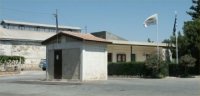
MCCS owns its premises which include the bank, the agricultural store and the supermarket. It also owns land for future plans. Customers include local people, ex-patriots, people who originally come from Maroni Village and now live in town, other villages or abroad. The company offers very good banking terms on deposits and a low interest rate in borrowing money. Currently deposits are over five million pounds and loans are in the region of four million pounds.
Apart from banking, many other services are offered to customers such as payment of bills like electricity, telephone, agricultural insurance, social insurance, road tax licence etc. Farmers receive all government support funds and get paid for their crops, lemons, carobs through the company.
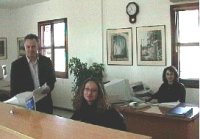
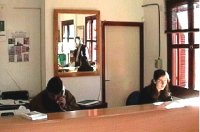
At the moment the Company employs seven people, three at the bank-Mimis, Maria and Kika, two at the agricultural store-Andreas and Eleni and two at the supermarket-Bitsa and Maria. Future plans include growth of deposits, employment of more staff members, offering of more services to customers such as payment of standing orders, credit cards, insurance schemes etc.
|
|
Life in Maroni Fifty Years Ago by Mimis Neocleous
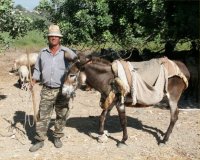
People in Maroni, in the majority, being farmers, lived in stone or mud-brick houses, usually built with the help of the owners and a builder. Water was carried into the house in buckets from stand-pipes in the main road, and collected with the help of donkeys, from wells and the river, as the houses did not have a water supply, there was also no electricity or telephone line available.
Food was usually their own produce of bread, beans, macaroni and fresh vegetables. On Sundays, they would have chicken from the backyard, and every Christmas, Easter or on a big day, there would be a speciality of pork for Greek Cypriots and lamb for Turkish Cypriots. Halloumi and olives were always on the table and milk from their own sheep or goats. Fruit would have usually consisted of local produce, such as oranges, watermelons and melons. Although Maroni is near the sea, there were no fishermen in the village, but a couple of people would use dynamite to fish, which was illegal and dangerous. Hunting was a way of life for many, which meant having meat on the table for special days. Cooking was done in the traditional way in earthy or tinned equipment, by burning wood in a stone fireplace. Food was kept fresh by covering with cloths, and hanging high near windows, or other airy places, inside the house. Shopping was done locally, in tiny shops, usually the local coffee shops. There was not much to buy anyway !!
Washing of clothes, was done in stone basins, and cleaned with warm water and alousiva, a traditional soap. There were no doctors in the village, people would go to town, for an injection or tablets. They would die young, and sometimes helpless, because their illness could not be diagnosed, or due to lack of treatment.
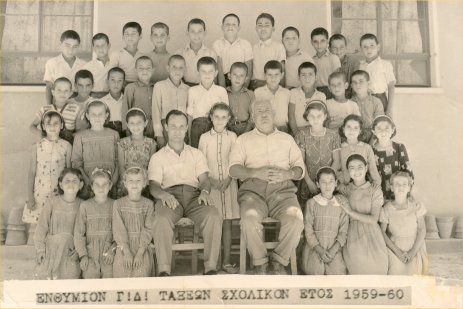
Churches in Maroni, were the same as today – the two St. George churches and the now, derelict, mosque, which also contained a school for the Turkish Cypriot children. There was no electricity and night-time service, took place with the use of candles, people used to go to church more frequently then. The present Youth Club was the school for Greek Cypriots, which moved to the present buildings in the late nineteen fifties. Most of the people were uneducated, an Elementary school certificate would be their highest achievement. Some boys tried secondary education, but only a few managed to succeed, and there were no university graduates in the village. Higher, even state, education was expensive at the time. In Maroni, being an agricultural village, young people preferred to work in their fields, rather than go for further studies, which meant going somewhere else to live and work – town or abroad. People started work early, with the first daylight, to make most use of it, since they had no electricity, no cars, only animals (donkeys) to bring them home, late at night.
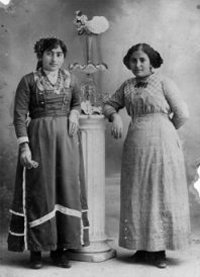
Clothes were hand-made, usually by the wife, mother, grandmother or relatives, and sometimes by a local dress maker, if they could afford it. Only one or two families had a car, and there was only one bus, that would go to town, once a week, and was also used to transport building materials and animals when needed.
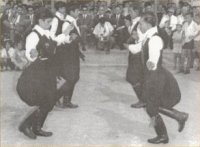
Grandparents were key figures in families, they would support their children and grandchildren financially, and help with the work in the fields, and also in the house. There was a lot of respect for grandparents, who took most of the decisions and responsibilities for a family. Entertainment was very little, but enjoyable, for men, playing cards and drinking zivania and wine in the local kafenio (coffee shop), especially on rainy days, when people wouldn’t go out to work, and for women, coming together in a house in the neighbourhood, and having coffee, and talking about their worries and problems, and generally doing embroidery work and sewing. Children, would play various games in the village square, church and schoolyard. Local weddings were a cause for real entertainment, there were only two to three weddings a year, and people would look forward to having a good time. They would all help with the food and drinks, and dance to the sound of violin and laouto, a local Cypriot lute for Greek Cypriot weddings and a zorne, which is a flute and daouli, a large drum, for Turkish Cypriot weddings.
Holidays ? An unknown word !! Nobody could afford a holiday abroad. Young village men, even married, would travel abroad, not for a holiday, but to look for work and a better future for themselves, and their families left behind. They would travel mainly to England and Australia by ship. Yearly income was very low, wages as little as 25 cents a day for a labourer or 35 cents for a builder per day.
Communications were difficult, no telephone in the house, and no local telephone. One could only communicate by writing a letter, which took a long time to reach its destination.
Life, generally, in the village was peaceful and quiet, people had a hard, but, easy going life, with no pressure. Greek and Turkish Cypriots were living, working and having a good time together in the village. People would sleep outside of the house, on the terrace, in the summer, their houses left open all the time, they had no security problems with real friendship, and their relationship and daily lives revolved around cooperation.
There are many more interesting tales to tell of this era,
|
| |
|
Harvesting (By Mimis Neocleous)
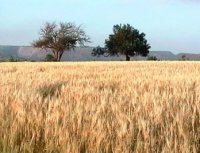
May is harvest time in Cyprus. As you have probably noticed the crops are ripened and are ready for collecting.
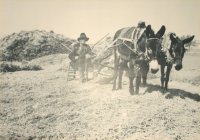
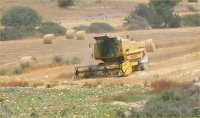
Harvesting used to be a very difficult procedure and most of the work was done by hand with the use of certain ancient tools such as a hand sickle Animals were used to carrying the products. Each individual was responsible for marketing and selling his product. Nowadays machines have taken over and made the procedure very easy. All the village crops are gathered in Zygi and trading is done collectively.
The harvest in Cyprus has been one of the farmer’s main source of income for hundreds of years. In our village it is no longer the main income anymore. For many years now the government have given subsidies to farmers so that their income from crops was reasonable and also insured their crops from bad weather.
Joining the European union will bring many changes to farmers... Subsidies will stop or change and government will not guarantee their income. But there will be subsidies for new machinery like tractors and combine harvesters
|
|
Farmer Makis Demetriou
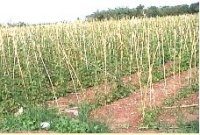
We met Makis a few days after the high winds had hit Maroni, which is a major problem with local farmers. In two hours his green beans had been destroyed at a loss of approximately £4000, with no government grant or insurance to cover this devastation. From his demeanour, it was obvious it would take considerably more suffering before this hard working farmer would give in to the elements. Another problem all farmers have is the competition from “amateurs” and he feels that farmers should be registered, only about twelve per cent being authentic, and the markets should only accept produce from those registered. Not enough produce is exported and when the prices are high there is competition with imported goods.
Makis was born in Maroni and his parents and one of his brothers still live in the village. His father, now 82, still works and like his father before him was also a farmer. Makis has one other brother, who lives in England and two sisters, one of whom helps him on the fields, live in Larnaca. He went to the local Elementary school and the American Academy until 1977, when he went into the army. After that he was an accountant at the Vassiliko Cement works for three years and in 1982 married his wife, Andria. It was at this time he commenced farming full-time, although as a youngster he had helped his father. They have two children, a daughter, Rebecca aged eighteen and a son, Demetris aged fifteen. He grows all kinds of vegetables on a number of plots of land around the village and has greenhouses near the “old wreck” along the Zygi sea front. At the present time he is picking olives to sell the oil wholesale and his vegetables he sells to the local Maroni Farming Co-operative along the old Limassol-Nicosia road near the Tochni turning. He realises there is a problem with disposing of the plastic sheeting used for the green houses and thinks it a good idea for the Government to supply re-cycling bins for this sheeting.
More than thirty per cent of farmers have to have second jobs to support their families and in Makis’s case he buys and sells land. If anybody is interested in land transactions then please call him on 04-332170 or 09-403780.
|
|
The local shepherd
Mr Theodoros Lazarou and his wife Nitsa have been local shepherds in the Maroni area for the past fifty years. They have a farm in the farming area of the village but I am sure most of you have seen him out and about in the fields with his sheep and goats.
Theodoros was born in Maroni and the farm has been in the family for about eighty years, three of his children used to work in the farm, but now just one of his children and his wife work with him. Business is steady with about 250 – 300 sheep to care for, this is a full time job and as they need feeding and milking everyday they have to work 365 days of the year, even Christmas day!
Over the years the business has not really changed except for the rebuilding of new farms and some new equipment to comply with new regulations.
Theodoros also has some land in the area that he plants barley and wheat in, he harvests this and uses it as feed for the sheep and goats.
Sheep are one of the only animals that you can sell everything they produce, you can sell the milk, fur, meat, and the manure.
About twenty years ago Theodoros wife Nitsa use to take milk home and produce halloumi cheese, anari cheese and she would make the village homemade yogurt . They would sell the produce to friends and local people in the villages and whatever remained take home for personal consumption.
Nowadays the milk is collected by the big companies such as Charalambides and Pitas diaries and taken to the factories.
Since entering the E.E.C barley has gone up in price from seventy pounds a ton to one hundred and twenty pounds a ton this has made business a little less profitable but the government is now giving a grant of seven pounds a year for each sheep you keep.
|
|
Carob Growing
by Mike Demetriou.
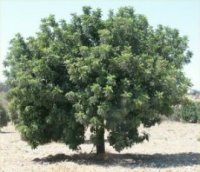
Over 50 years ago, the main trees in our village were Carob trees. We used to look after them carefully, as they were the main income of our villagers. Just for you to realise, over 60 years ago, my father, when choosing his portion of my grandfather’s land, instead of retaining land near the sea, without trees, now worth £200,000, preferred to keep land consisting of 10 Carob trees, to obtain income, which now has little value.
However, 40 to 50 years ago, the villagers started picking Carobs by the end of August, and within two to three months they would be delivered to Zygi at large warehouses, originally by donkeys, as there were no tractors or lorries, but with progress this is now the mode of transport.
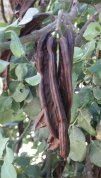
About 20 years ago, greenhouses started to be erected in the village and this became the main job, instead of Carob picking. Unfortunately this has resulted in the loss of Carob trees, to make room for cultivating crops and greenhouses. Carobs are used for many things, such as, making syrup, cocoa, fruit for Arabic countries, music tapes and for animal fodder, and 228 kilos will fetch about £20, and the Government is trying to help, by giving subsidies of 7 cents for every kilo collected.
|
|
The local Olive Press factory.
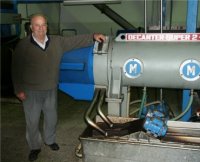
Vassos Charalambous Olive Press Company is situated on the Kyriakou Matsi road, between Psematismenos and Choirokitia. It is run by Mr Vassos Charalambous and his two sons Harry and Nickos. Vassos lives in Choirokitia with his wife.
He, like his father before him, has been pressing olives for many years. Over the years many changes have taken place in the olive pressing business, from the use of mats, with olives between, pressing under their own weight, and the old type millstones, driven by a donkey, up to the present day modern machinery. The amount of oil, and the quantities given with the new machinery, is far greater than the old methods. Mr Vassos Charalambous has been pressing olives in Choirokitia with these types of machines since 1962.
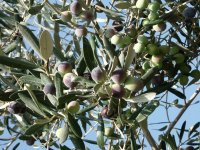
The olive pressing season runs from the beginning of October to the middle of March. Machines at his new factory can press 8 tons per hour with all 3 machines in full swing. The number of tons passing through the factory has increased in the last few years, as more people are planting olives on their land. About 4-8 Kilos of olives make 1 kilo of oil, the difference is in the quality and type of olives grown, and the time of year they are harvested. If the olives are picked in October, they give less oil than in February, but the weather will have taken its toll on the trees, so olives are lost the longer they are left on the trees.
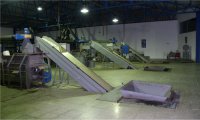
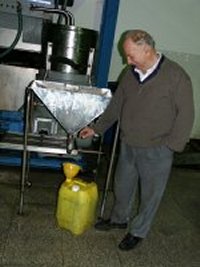
Processing the olives occurs in five stages. The olives are tipped into hoppers, where a conveyor picks them up and drops them through a fan, which removes the leaves and bits of twigs. They are then washed, and from there, they move to the crusher. After crushing, the mash is left in a mixer, which is heated to 60o c for an hour before going on to the separator, which separates the oil, water, and left over mash, which includes the pips.
The left over mash is sent to another factory, where olive oil can still be extracted, but at a far less rate, and is not very good in quality. The water from the process is not wasted, as it is left to stand, and the crust that forms from the residue can be used back on the land as fertiliser, with the water used to water plants. The cost of pressing olives in the factory is £7:00 up to 100 kilos, after that it is 7 cents per kilo.
After the end of the season, Mr Vassos Charalambous and his sons run the large restaurant situated on the opposite side of the road, which is used for large weddings, christenings and parties seating 1700 persons. Also, along side of this, a smaller building is used seating 400 persons.
If you have your own olives to press, or if you would like to buy the fresh olive oil at £3:00 per kilo, call in You will then be able to try a unique experience of toasted village bread with fresh olive oil and lemon juice, yum,yum,yum.
Phone contact the factory 24-323242. Phone contact the large restaurants 99-493939. |
|
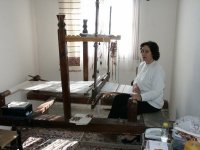
Loom weaving in the village of Maroni.
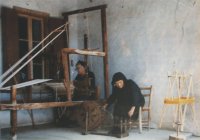
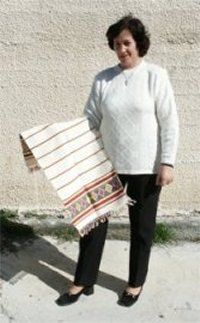
Mary originally lived in the old village of Phiti, just outside the town of Paphos, where all the young girls were taught the art of weaving, she said that “If you were no good on the loom, you were a not a good woman”. Learning the art of weaving from an old woman in the village, it had been passed down through the generations for hundreds of years. Some of the very old looms are still in use today as they have not changed much over the years. Today the girls in her old village are weaving as a way of making an income.
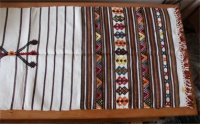
Most of the weaving was done in silk thread, she remembers in her young days that being part of that traditional village life. Silk worms where cultivated in the villages all over Cyprus, and yes even in Maroni, grown by the old bridge near the river where some of the old SY??????? (Sycamorerear, the Mulberry Tree) trees can be seen today. Nowadays the loom weave uses cotton threads of many colours, still on a plain background.
She married Argyros Agapiou in 1980, who is a local man. Argyros is a local farmer who grows Tomatoes, Cucumbers, Peppers and Aubergines; he is the son of the lady who sells strawberries at the Kalavasos crossroads. He is also a handicraft artist in his own right, creating wood carvings and working with copper.
About 3 months ago Mary started work on the loom again, she now makes small tray cloths, small table cloths, curtains and cushion covers. She works on her own and sends all of what she makes to the Cyprus Handicraft Centre, Nicosia, where many original crafts, used throughout the Island, have been put together under one roof, this is well worth a visit. If you would like some of the traditional style fabric, do give her a ring or call in.
Telephone 24332132. Mary Agapiou,
11 Apostolou Louca Maroni Larnaca
. |
Maroni News all editions from 1999 - Latest printed . |

All articles above taken from the village news paper, much more information on village at work, recipes, archeology and articles from residents can be viewed by clicking the above link or going to www.maroninews.net/ |
|
|
|
|